

Discovering What You Love in a Multicultural Environment
APU Student Portfolios

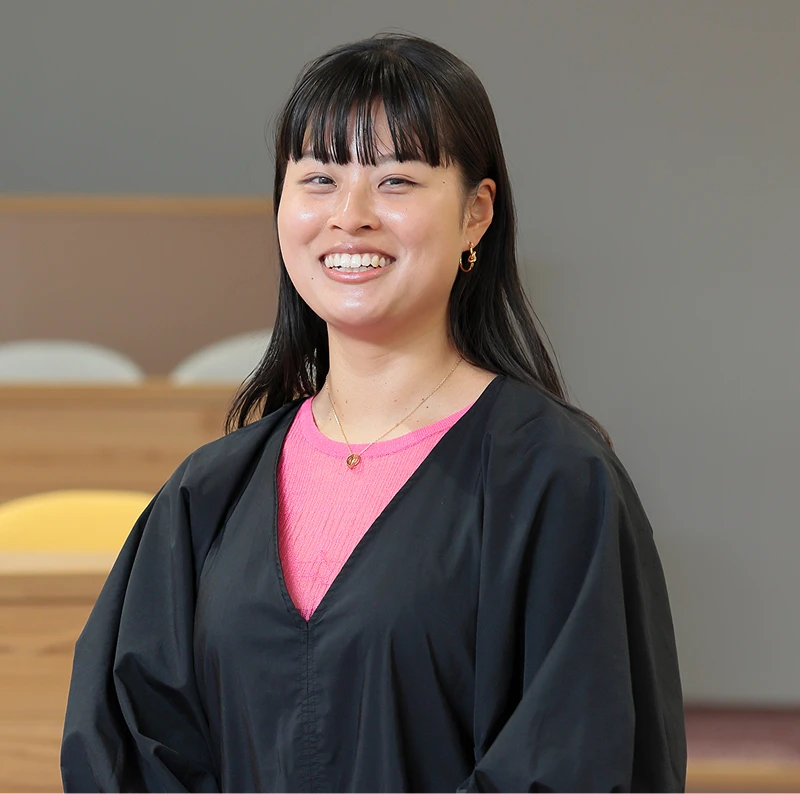
PROFILE
Anji Nishigai
*Interview conducted in January 2026.
The Joy of Deepening My Expertise While Exploring My Interests and Future Goals
With High Hopes of Contributing to Regional Revitalization in a Place I Have Never Lived Before
JOURNEY
The Journey to Discovering What I Love

- Child Loving and Learning English Since Elementary School
-
Grade
10 Joining the International Course to Further My Passion for English -
Grade
11 Studying Abroad in Houston, Texas, USA -
APU
Year 1 Developing an Interest in Development Studies Aimed at Solving Global Issues -
APU
Year 2 Took Professor*Rikio Kimura's* “Development Socio*ogy and Anthropology” Course -
APU
Year 4 Graduation Thesis on Community Development and School Organizations -
Post-
Grad Joined a Company Focused on Adult Education and Regional Revitalization
What were you like in high school?
Wanting to learn more English, a subject I had loved and studied since elementary school, I chose a high school with an international studies course. The school was famous for its volleyball program, and I was inspired by the dedication of students who devoted themselves to their club activities. That motivated me to focus on what I could work hard at, and I poured my energy into my studies. In my second year of high school, I studied abroad in Houston, Texas. There, I learned firsthand that what I had always taken for granted was not necessarily taken for granted by others.

What made you decide to enroll at APU?
I felt that I needed to continue studying English, and if I was going to attend university, I wanted a place where I could learn something beyond English. APU was well suited to what I was looking for.

What were your initial impressions of university life?
In high school, I mainly studied to earn good grades. At university, however, I felt that learning was about exploring the fields that truly interested me while thinking about my future goals and career path. What surprised me about APU was that so many students already had dreams and ambitions when they entered the university. Many of them had a clear vision of what they wanted to do and become, which left a strong impression on me.
How did your interests and areas of focus change or expand after entering APU?
The issues of poverty and the environment in developed countries, which first caught my interest during my study abroad experience in the United States in high school, were key factors in my choice of university. However, as I took a wide range of courses at APU, my perspective broadened, and my interests gradually shifted toward development studies, a field dedicated to finding solutions to global challenges from a wider perspective.
What has been the most memorable class you have taken so far?
In the latter half of my second year, I took Professor Rikio Kimura's “Development Sociology and Anthropology”* course, and it was there that I first encountered the concept of development studies. Although I found it challenging, I was also fascinated by it, and I realized that I had found a field I wanted to explore in greater depth.

What did you write your graduation thesis on?
During a seminar field study, I visited Toho Village in Fukuoka Prefecture, where my team proposed a project aimed at regional revitalization through English education, career education, and local heritage education for children. The proposal was ultimately adopted by the village. To further support the initiative, I took a leave of absence from university and spent six months living in the community through the Community-Reactivating Cooperator Squad Internship Program. As I worked alongside local residents on community development, I observed not only changes in the children who participated in the program but also challenges within the school organization itself. These two observations eventually became the foundation of my research, and I wrote my graduation thesis based on them. The title of my thesis was “The Sustainability of Cross-Disciplinary Education: Transforming Intrinsic Motivation into Action and Structural Challenges in School Organizations, A Case Study of the 2024 Educational Program Conducted by APU and Toho Village, Fukuoka Prefecture.”
What new insights did you gain during your time at university?
In Toho Village, I witnessed firsthand the positive changes that various learning opportunities could bring to children. For example, I saw a child who had struggled with English grow more confident after interacting with APU’s international students, saying, “I want to speak more” and “I want to study more.” Seeing that kind of growth inspired and motivated me as well.
My seminar advisor, Professor Rikio Kimura*, spent ten years in Cambodia working on community development before joining APU. Observing his approach taught me the importance of supporting communities from the same perspective as local residents and working together to improve the region.
I was also a member of Habitat APU, a student organization that focuses on housing issues in underserved communities. Through the organization, I participated in a volunteer project to build houses in Cambodia. These experiences taught me that support is not about “helping others” from the outside, but about getting to know one another, working together, and building relationships based on mutual understanding.
What are your plans after graduation, and what are your goals for the future?
I will be joining a company involved in adult education and regional revitalization. Although the company is headquartered in Tokyo, many of its projects are based in Kyushu, and I look forward to the opportunity to live in a place I have never lived before. Even as a working professional, I want to keep challenging myself, continue learning, and embrace new opportunities without limiting myself to a fixed path.
Do you have a message for prospective students?
The five years I spent as a university student, including my leave of absence, truly passed in the blink of an eye. Looking back, there are certainly things I wish I had done more of during my first and second years. My advice is to discover your interests and passions early on, and then continue to pursue them more deeply as you progress through your third and fourth years. Finding joy in learning and expanding your knowledge are both important parts of university life.
When I first entered APU, President Deguchi Osamu often emphasized the importance of three things: travel, people, and books. I, too, have always valued these three things. I hope you will keep them in mind and enjoy a meaningful and fulfilling university experience.
* Under the 2023 curriculum, this seminar is part of the College of Sustainability and Tourism.