

Discovering What You Love in a Multicultural Environment
APU Student Portfolios

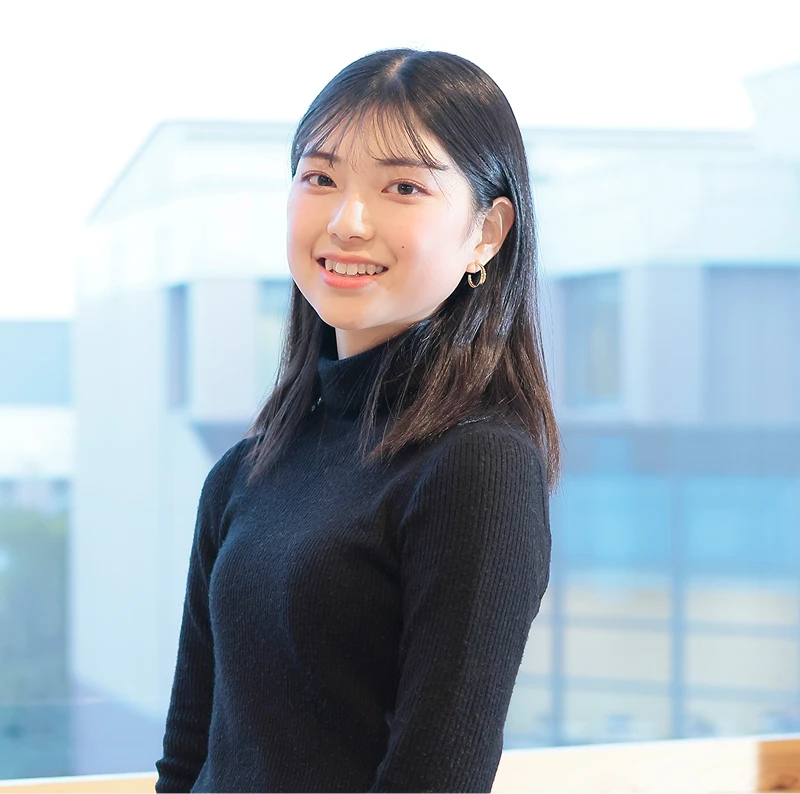
PROFILE
Rin Takamura
*Interview conducted in January 2026.
Experiencing the Local Memory of War and Invasion Firsthand Through an Exchange Program in Poland.The Insights and Broadened Perspectives Gained at University Shaped My Graduation Thesis.
JOURNEY
The Journey to Discovering What I Love
- Child Moved to the U.S. with my mother at age seven and spent four years there.
- JH/HS A Deep Interest in the World
-
APU
Year 1 Struck by a Class “Peace, Humanity, and Democracy” -
APU
Year 3 Exchange Study at the University of Warsaw, Poland -
Return
to APU Joining Professor Fuchinoue's Seminar -
APU
Year 4 Researching Security Through the Concept of Nuclear Deterrence
What were you like in high school?
I was always a very curious person with a strong interest in the world itself. My high school offered different academic tracks based on students' strengths and university aspirations, and I enrolled in the International Studies program, which focused on improving English proficiency and deepening international understanding. From the age of seven, I spent four years living in the United States with my mother, whom I deeply admire, while she pursued her master's degree. Later, during high school, I also took part in a three-month language study program in Canada.

What made you decide to enroll at APU?
I had already heard that APU was an excellent university, and several alumni from my high school had gone on to study there. When I was struggling after my university entrance exams did not go as well as I had hoped, one of my high school teachers encouraged me to consider APU, which made me realize that I still had an opportunity ahead of me. Rather than pursuing studies related to business or creating products and services, I wanted to study the disciplines that help build and sustain the foundations of society and its institutions, rather than business itself or work focused on creating things. That is why I chose APS.
How did you find university learning different from learning in high school?
It surpassed my expectations in every respect. Not only did it greatly broaden my perspective by bringing the world closer to me, but it also strengthened my academic English skills. Even in daily life, discussions often ranged from politics and religion to highly specialized topics, giving me countless opportunities to engage in intellectual debate in English.
What was the most memorable class you took after enrolling at APU?
The course that had the greatest impact on me was “Peace, Humanity, and Democracy,” a general education course taught by Professor Hideki Fuchinoue in my first year. Among the works that left a particularly strong impression on me were Man’s Search for Meaning by Viktor E. Frankl, which recounts his experiences in a concentration camp, and the farewell letter of Ryoji Uehara, a kamikaze pilot. Through these works, I began to think deeply about the impact of war on society and on the human mind. This sparked the questions that would guide my academic journey, became a cornerstone of my learning, and ultimately laid the groundwork for my graduation thesis.
What experience during your time at university made you feel that you had grown?
The experience that contributed most to my growth was spending a year on an exchange program in Poland, beginning in the fall of my third year. Poland is a country that has twice disappeared from the map due to invasion and partition, and living there allowed me to gain a firsthand understanding of the impact of war. At the University of Warsaw, I studied European international relations and deepened my understanding of the region from both historical and contemporary perspectives. I also visited Auschwitz, where I encountered emotions, experiences, and realities that could never be fully conveyed through textbooks alone. This study abroad experience has had a profound impact on both my future academic path and my graduation thesis.

What did you write your graduation thesis on?
I joined Professor Fuchinoue’s seminar and deepened my study of security issues, focusing on the concept of nuclear deterrence. Because I tend to think deeply about everything, deciding on a topic for my graduation thesis was genuinely difficult. However, as I worked through various academic texts and references, my research direction gradually took shape. I found myself particularly drawn to the realist perspective in international relations and wanted to explore it further. In the end, I examined international security through my thesis, “What Are the Limits of Nuclear Deterrence Between India and Pakistan?”.
How do you reflect on your four years at APU?
Through my experiences, I came to realize firsthand that studying and knowledge can serve as tools for connecting with a wide range of people. When you understand the background and history of another person’s country, conversations naturally become more meaningful, and those exchanges themselves motivated me to continue learning, especially in languages. While I remained focused on my studies, one activity that was equally important to me was my involvement in the student organization GASS, where I provided individual consultations for high school students attending APU’s open campus events. I was fortunate to be surrounded by many inspiring professors and wonderful friends, and I enjoyed a truly fulfilling student life.
What are your plans after graduation, and what are your goals for the future?
I will be pursuing a postgraduate degree in Europe. I plan to continue my research on international security and nuclear deterrence while broadening my regional focus to China and India, with the aim of examining how nuclear deterrence operates in different parts of the world. Although I am still uncertain about my future career path, I enjoy interacting with people and am also considering a career in teaching.
Do you have a message for prospective students?
High school is often a time of uncertainty and self-reflection, but my advice is to be yourself. Your worries and struggles can become opportunities for growth. Try not to be overly concerned about how others see you or compare yourself to those around you. Instead, hold on to what is truly important to you, find an environment and teachers who appreciate you for who you are, and make the most of your university years by studying something you genuinely find exciting and rewarding.