



The Path I Found Through Entrance Exams
There is no one-size-fits-all path to APU. From holistic admissions to external English qualification routes, students can challenge themselves in ways that suit their strengths. Here, ten successful applicants share their unique admissions journeys. Their experiences may offer the inspiration and guidance you need to discover your own path.
STUDENT INTERVIEW
APU Admission Success Stories❽
General Selection (Paper test)
Common Test Method (2 subjects+Data Analysis)
”Interest and Knowledge in Social Issues Strengthen Your Ability to Answer Questions”
-
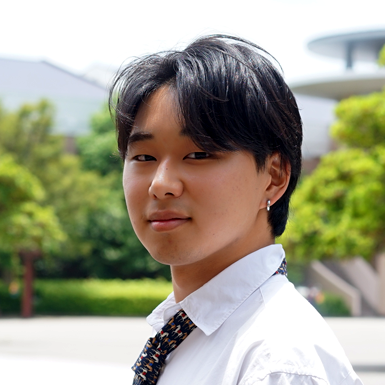
April 2026 Enrollment, College of Asia Pacific Studies
Hibiki Ando
Profile: A native of Aichi Prefecture and a graduate of Tokai High School. After completing the university entrance examination process at a highly competitive local high school while largely following the path taken by others, spending a year as a ronin (gap-year student), a documentary led to the discovery of APU and an immediate decision to change plans from applying to private universities in the Kanto region.
Although the first application through the Common Test Method was unsuccessful, strong mock exam results created a sense of confidence that led to insufficient preparation. Admission was ultimately secured through the Common Test Method (2 subjects + Data Analysis), which had been applied for concurrently.
To start, could you reflect on your high school years?
I attended a prestigious all-boys junior and senior high school with a long history. Although there were around 400 students in each grade, the atmosphere was one of mutual respect, which allowed me to enjoy a fulfilling high school experience.
While focusing on academics at this college-preparatory school, I also took part in an extracurricular initiative called the Saturday Program. As a member of the student organizing team, I helped plan and host lecture events featuring guest speakers from outside the school. Students were responsible for everything, from event planning and negotiating speaker fees to conducting interviews, coordinating meetings in advance, and managing operations on the day of the event. It was a valuable opportunity to engage directly with society beyond the classroom. The experience was both challenging and rewarding, and it gave me a chance to test my own abilities.
I spent my junior high school years in the concert band and joined the light music club in high school, so most of my time was spent in cultural and arts-related communities. However, after watching the FIFA World Cup during my high school years, I became interested in soccer. Between studying, I often spent time with friends from this new community, which helped broaden my horizons and enrich my school life.
We understand that you spent a year as a ronin before enrolling at APU. What was your first experience with university entrance exams like?
At my high school, most science-track students went on to medical school, while for humanities students, national and public universities were the most common destinations. I initially followed the same path and began preparing for entrance exams with the goal of attending a highly ranked private university in the Kanto region. However, having pushed myself too hard during my junior high school entrance exam preparation and experienced health issues as a result, I found it difficult to fully commit to studying and instead devoted much of my time to activities in the light music club and mountaineering club.
Since it was not uncommon for students around me to aim for highly competitive universities with the expectation of spending an additional year preparing if necessary, I did not feel particularly anxious at the time. In the end, I took the exams without being fully prepared and was unsuccessful. As I had not applied to any other universities, I began attending a cram school after graduation and started life as a ronin, preparing to retake the university entrance exams.
What led you to apply to APU?
Although my life as a ronin had begun, the demands of exam preparation still felt overwhelming, and time passed without me ever fully committing myself to studying. One day, while having dinner with my mother and watching television, I happened to see a documentary featuring APU. I was struck by the authentic student life in the international dormitories and the interactions among students from around the world. It revealed an appeal that could not be measured by rankings or entrance exam scores alone.
I had been interested in social issues from a young age and chose Politics and Economics as one of my subjects in high school. Seeing APU's diverse and multicultural environment, I felt it was the perfect fit for me. As soon as the program ended, I started researching APU online. Videos uploaded by students gave me a genuine glimpse into campus life, which I found extremely helpful.
Up until then, I had had no international experience whatsoever, and English had simply been a subject I studied from textbooks. Yet I quickly found myself thinking about nothing but APU, almost as if it were love at first sight.
Later, I learned about a campus visit event being held in August, so I boarded a plane and traveled alone to Oita for a two-day, one-night trip. Visiting APU in person only strengthened my determination to study there.

How did you choose your application method, and what was the actual exam experience like?
Looking at past admissions data, I felt confident that my academic performance was strong enough to gain admission through the Common Test Method, so I studied with a considerable sense of ease. Since I was enrolled in a preparatory school's humanities program focused on private university admissions, most of my preparation for the Common Test was done independently.
After taking the exam in January, I entered my estimated scores into the preparatory school's admissions prediction system, which gave me an A rating for APU, indicating a very high likelihood of acceptance. As a result, I became completely complacent. Even though there was still a month to go before the official results were announced, I felt as if my entrance exam journey was already over. At the time, I had also applied for the Common Test Method (2 subjects + Data Analysis) on the recommendation of one of my prep school teachers, but I viewed it mainly as a backup option.
When the results of the Common Test Method were released, however, I was unexpectedly rejected. I was shocked. Looking back, I realize that I had been too confident and failed to prepare as thoroughly as I should have, which is something I regret. The three days between receiving that result and learning that I had been accepted through the Common Test Method (2 subjects + Data Analysis) felt incredibly long.
I did very little specific preparation for the Common Test Method (2 subjects + Data Analysis). However, because I had always been interested in social issues, I had naturally built up a broad base of knowledge. I was also comfortable putting my thoughts and opinions into words, so I think my interests and skills happened to align well with the nature of the exam. Since this admissions method tends to favor applicants with a wide range of knowledge and the ability to think critically about current issues, I believe it is particularly well suited to people who regularly follow the news, gather information, and develop their own perspectives on the world.
Finally, what message would you like to share with high school students who will be taking university entrance exams in the future?
I would advise students not to rely too heavily on score predictions for the Common Test, regardless of which university or admissions method they are aiming for. It is important to apply through as many admissions methods as possible and continue giving your best effort until the very end.
I changed my first-choice destination from private universities in the Kanto region to APU, which, in terms of entrance exam rankings, could be seen as a step down. However, because I made that decision based on what I genuinely wanted, I have never regretted it for a moment.
If the goal you are working toward is one that you have chosen for yourself, I believe you can enjoy not only reaching it but also the journey along the way.

 Read More APU Admission Success Stories