



QUESTION New “Questions” Born from a Multicultural Environment
At APU, where diversity and multiculturalism are part of everyday life, your existing assumptions and ways of thinking can be completely transformed. If you ever feel uncertain or find yourself questioning something, that’s your opportunity. It’s the moment when new “questions” are born—taking the first step toward solving real-world challenges.
Q1. I have experienced moments when I felt that my assumptions no longer applied.
Survey conducted on February 16, 2024 (133 respondents)
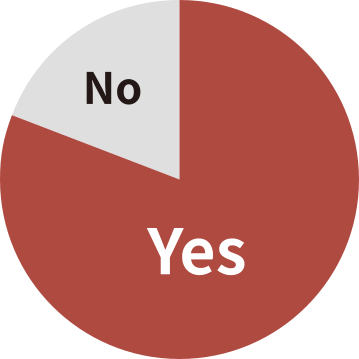
Survey conducted on February 16, 2024 (133 respondents)
Q2. Please tell us about any questions or doubts that have arisen since enrolling at APU, any social issues you have newly become aware of, or any experiences that have challenged your previous assumptions or changed your perspective.
-
Are there differences between job hunting in Japan and overseas?

Second-year student, College of Asia Pacific Studies Ryuga Inamura
The experience that most challenged my assumptions was learning about the concept of a gap year. Until then, I had never even considered taking a leave of absence from university as a valid option. I could not understand why someone would take time off school to participate in internships or volunteer activities, and to be honest, I used to think, “Isn’t taking a leave of absence just a selfish and indulgent choice?”
However, after coming to APU, I saw many friends and senior students actually taking leaves of absence. I also learned from international students that in many countries, job hunting typically begins after graduating from university, not during one’s studies. This made me realize how narrow my perspective had been.
Reflecting on this, I began to question Japan’s job-hunting system. Generally, job hunting in Japan takes place from the latter half of the third year through the fourth year of university. Once students secure a job offer, many end up taking classes just to complete the required credits for graduation. While students enter university with enthusiasm and pay significant tuition fees, ideally they would want to devote the full four years to learning before starting job hunting. However, that is not the current reality. Within less than three years, it is quite difficult for students to gain sufficient experience, develop skills, or fully establish their sense of self to prepare properly for job hunting. In fact, within the context of Japan’s system, it even seems wiser to take a gap year to gain experiences such as volunteering and to spend enough time on self-reflection.
Of course, including myself, many people cannot take a gap year due to financial or other constraints. Moreover, it is nearly impossible to fundamentally change Japan’s job-hunting system. Therefore, to help students begin preparing for job hunting as early as possible, I am currently a member of WANTTO, an organization that promotes self-analysis. Through organizing events and activities, we aim to help APU students, especially first- and second-year students, gain a clearer vision of their future and better prepare for their careers.
-
What kinds of social issues arise due to differences in countries and cultures?

First-year student, College of Asia Pacific Studies Rinko Arai
Since enrolling at APU, I have encountered different cultures and values, which has led to many questions and uncertainties. Differences in language and customs have provided me with new perspectives, and through interacting with peers from diverse backgrounds, I feel that my own worldview has greatly expanded.
One social issue I have newly become aware of is environmental problems. Differences in customs and policies across countries have made me reflect on their impact on the global environment. I have come to understand the importance of sustainable living and environmental protection, and I believe it is essential to translate this awareness into concrete actions.
Furthermore, my experience of collaborating with international students has reshaped my assumptions. Through discussions and project work with people from diverse backgrounds, I have become aware of my own fixed ideas and biases and have developed a more flexible way of thinking. I believe this will be a valuable skill for succeeding in a global business environment in the future.
I feel that my international university experience is gradually transforming me into a more adaptable individual by exposing me to new perspectives. I strongly realize that awareness of global issues and efforts toward coexistence with diverse cultures will become increasingly important in the future.
From the new perspectives I have gained through collaboration with international students, I have started to actively engage in environmental issues. I am reassessing my own lifestyle by focusing on reducing waste and promoting reuse, aiming to lessen my impact on the planet. In addition, I participate in environmental projects on campus, contributing to awareness-raising activities and the organization of sustainable events.
To promote coexistence with different cultures and deepen dialogue and understanding, I am also working with fellow students to organize intercultural exchange programs. Through these initiatives, we aim to create an environment where students from diverse backgrounds can respect one another and collaborate toward shared goals.
Furthermore, I understand the importance of cross-cultural communication in the business world and actively participate in projects involving international collaboration. By utilizing flexible thinking and a cooperative mindset, I work with team members from diverse backgrounds to solve problems. These experiences are helping me expand both my skills and perspective, preparing me for future leadership in a global business environment.
-
When discussing food loss with international students…

First-year student, College of Asia Pacific Studies Naho Oda
When I was discussing how to utilize food loss ingredients with international students, I initially thought that food loss—such as agricultural products that cannot be shipped due to damage—could be turned into new food products and commercialized. However, from the perspective of one international student, they could not understand why damaged food loss ingredients would be turned into products and sold.
When I asked about the reason behind their view, they explained that in their country, it is prohibited for individuals to sell such items, and selling products made from damaged ingredients would be unacceptable. On the other hand, when I asked other international students whether personal selling was allowed in their countries, some said that it was possible and even agreed with my idea.
Through this experience, I realized that people’s ways of thinking are strongly influenced by their cultural backgrounds.
This experience also increased my interest in learning about different cultures. I began to compare other countries with Japan, looking for both differences and similarities, and I have started to actively participate in cultural exchange activities.
-
Do Japanese people really understand their own country well?
First-year student, College of Sustainability and Tourism Ikumi Kamei
What I newly realized after enrolling at APU is that Japanese people tend to have a limited understanding of their own country. At university, when I ask international students questions like, “What is your country like?”, most of them are able to explain without hesitation. In contrast, when I was asked the same question, I found it difficult to give a clear answer.
Additionally, I have sometimes been told by international students that Japanese people do not know much about their own country’s history or politics. In an era of increasing globalization, while international education is gaining attention and people are encouraged to look outward, I realized that learning about one’s own country may be neglected in the process.
Based on this realization, I believe it is important to study more about Japan. I have started to actively follow the news and take courses where I can learn about Japanese politics and history. Understanding my own country will help me establish a clear identity as a Japanese person when I study abroad in the future.
Furthermore, I believe that learning about one’s own country is the first step toward keeping up with an increasingly globalized society, and I am taking action accordingly. By first understanding my own country and then learning about the history of other countries, I believe I can better understand cultural backgrounds. This, in turn, can help foster tolerance toward cultural differences and potentially contribute to addressing fundamental issues such as discrimination against foreigners.
-
That ‘common sense’ isn’t necessarily the only right answer!

Third-year student, College of Asia Pacific Studies Shiori Tsukioka
Through group work in class, I began interacting with international students, and I was shocked to realize that what I had taken for granted in Japan—such as strictly adhering to time and deadlines—is not necessarily universal. I also experienced for the first time how religion can affect daily life, such as limiting where and when I could eat with friends.
In terms of social issues, I noticed that many international students from Southeast Asia tend to view their own countries as developing nations facing various challenges, while seeing Japan as a developed country in Asia. I also feel that global issues have become more personal to me, as there are students from countries with unstable domestic situations. For example, several students from Indonesia talked about their country’s rapid economic growth alongside environmental pollution. Additionally, when the military coup occurred in Myanmar, students from Myanmar were sharing protest movements on social media.
Regarding differences in time perception, through repeatedly having similar experiences in group work, I came to understand that my way of thinking is not the only one. As a result, I no longer feel frustrated or troubled by such differences. Personally, I cope by preparing other tasks that I can do while waiting.
In terms of religion, when spending time with Muslim students, I go to halal restaurants or cook meals using only ingredients they can eat. During Ramadan, I also avoid eating in front of them during the daytime.
As for social issues, in the past, I tended to view news about other countries as something distant and unrelated. However, now I perceive them as events happening in my friends’ home countries. Whenever I have the opportunity, I actively ask students from those countries for their perspectives and engage in discussions, even on complex issues.
-
Are you making assumptions about someone’s nationality or gender based on their appearance?

Second-year student, College of Asia Pacific Studies Chiaki Tasumi
Making judgments about someone’s nationality or gender based solely on their appearance can be problematic. For example, asking “Do you have a boyfriend/girlfriend?” instead of “Do you have a partner?” assumes that the person is heterosexual. Calling someone “older brother” or “older sister” without knowing their gender identity can also impose assumptions. Telling someone with non-typically “Japanese” features, “Your Japanese is very good,” draws an unnecessary line by treating them as a “foreigner.” Similarly, casually greeting someone who is using Chinese with “Ni hao” may unintentionally group different backgrounds together or overlook the political sensitivities surrounding certain countries and regions.
At APU, it is also common for students to have different places of birth and upbringing, or to attend university for more than four years due to taking a leave of absence. There is a shared understanding that it is natural for others to be different from oneself.
Since coming to APU, I have become more mindful of the language I use so that I do not unintentionally hurt or exclude others—for instance, saying “gaikokujin” (foreign national) instead of “gaijin,” and “bilingual” rather than limiting linguistic identity to just two languages. I also try to approach others as individuals rather than defining them by nationality or gender, and I consciously avoid applying stereotypes such as “because they are from ○○.”
I have come to appreciate that having different backgrounds and perspectives is something valuable, and I now see it as an opportunity to learn and gain new insights. Furthermore, through the many group work experiences at APU, even when challenges arise due to differences in cultural background or religion, I do not give up on collaboration. Instead, I focus on finding solutions by asking, “How can we better understand each other?”
-
What does ‘peace’ mean to each individual?

Fourth-year student, College of Asia Pacific Studies Kota Watanabe
The most shocking experience for me was when I was discussing ongoing conflicts around the world with an international student. Suddenly, I was asked what I thought about the wars currently taking place. I was unsure how to respond, and the only answer I could come up with was, “I hope they can be resolved peacefully.”
After hearing my response, my friend seemed somewhat convinced and then asked me, “I see—but whose peace are you referring to?”
That moment made me realize firsthand that the world looks different depending on the perspective from which it is viewed. At the same time, it significantly changed my epistemological belief that there are universal values shared by everyone.
This experience led me to reconsider my future career. After graduating from APU, I am planning to pursue graduate studies, and afterward, I hope to work for an international NGO, making use of the expertise I gain. Initially, I had doubts about the concept of “development,” as it is often criticized as imposing the values of those who provide it. However, through this experience, I came to understand the importance of having my own sense of justice.
There are diverse forms of “justice” in the world. Recognizing this, I now believe it is important to develop my own sense of justice and actively engage with global issues. I aspire to contribute to solving problems around the world through my own actions, grounded in my personal beliefs and values.
-
There are so many different cultures within religions around the world.

First-year student, College of Asia Pacific Studies Iwakiri Haruna
One day, a Muslim friend asked me to cook yakisoba. When I went shopping for ingredients, I realized that not only pork but also processed meats such as sausages and bacon contain pork, so I could not buy them. In the end, I bought a seafood mix and headed to my friend’s house. When I arrived, there was also a friend who follows Hinduism. Since Hindus do not eat beef, if I had bought beef, that friend would not have been able to eat it either.
It was the first time I had to be so careful about the ingredients I used when cooking for friends, and it was a fascinating experience that went beyond my usual assumptions.
Thanks to this experience, I became interested in religion, especially Islam. I learned that even among Muslims, there is a wide range of practices—from those who are very strict to those who are more flexible—so it cannot be generalized in a single way. I also attended an Islamic festival held in Beppu, where I discovered that many followers of Islam are not only in the Middle East but also in Southeast Asian countries such as Indonesia and Malaysia.
I realized that Islam is culturally diverse and that its practices vary depending on the country and region, which further deepened my interest. At university, I plan to participate in events such as Bangladesh Week and take courses related to religion. One of my goals this year is also to read the Qur’an, the holy book of Islam, in its entirety.
-
Does ‘global’ mean that everyone can participate and thrive equally?

Fourth-year student, College of International Management Mao Sato
When I was in high school, I believed that being “global” meant that everyone could participate and thrive equally. However, after enrolling at APU, I began to question whether it is truly possible to achieve equality in areas influenced by capital, such as study materials, clothing, time, and money—all of which are closely related to student life.
While spending time with classmates, I encountered friends who live very comfortably with financial support from their parents, as well as others who struggle to make ends meet on scholarships alone and must work part-time jobs while studying. Through these experiences, I came to realize that what matters is how each individual assigns value to their own student life.
Based on this realization, I became interested in the system of capitalism. I started working part-time at Ritsumeikan’s Social Impact Fund and became engaged in various social issues. Through these experiences, I developed an interest in people who create value—both for themselves and for others.
-
Is it easy for foreigners to live in Japan?

Fourth-year student, College of International Management Hana Uchiyama
Since enrolling at university, I have begun to question the differences in how foreigners (international students) are treated. In Japan, when working part-time, many adults speak to Japanese people in a normal, polite manner, but I have often seen them speak casually and sometimes roughly to foreigners.
I also felt that at places such as government offices and post offices, procedures can differ between Japanese and foreigners, and in some cases, they are more complicated for foreigners.
I believe that whether someone is Japanese or a foreigner, we should not change our tone or manner of speaking. Instead, we should treat everyone with equal respect as human beings, and I try to be mindful of this in my own communication. Additionally, I feel that society as a whole needs to develop better systems in order to bridge these kinds of gaps in the future.